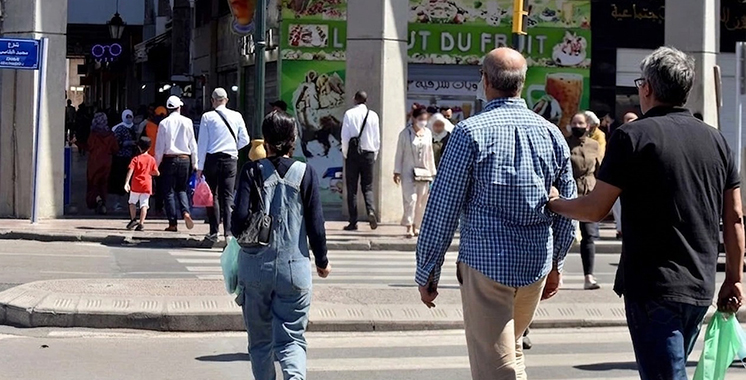
More than a third of Morocco’s working population walks to their workplace, according to a new note published by the High Commission for Planning (HCP) based on data from the 2024 General Population and Housing Census.
Walking accounts for 35.8 percent of commuting modes among employed active persons aged 15 and over, making it the most widely used form of transport across the country — ahead of the private car at 14.6 percent, motorcycles and bicycles at 12.3 percent and taxis at 10 percent. The employer-provided vehicle or shuttle accounts for 9.5 percent of journeys, while structured public transport remains marginal: buses carry 6 percent of working commuters, trams 0.5 percent and trains 0.4 percent.
The dominance of walking is even more pronounced in rural areas, where 42.4 percent of workers go on foot, compared with 32.7 percent in urban settings. Private cars, taxis and employer transport are significantly more prevalent in urban zones, reflecting the wider availability of motorized options and the greater distances involved. In contrast, motorcycles and bicycles play a larger relative role in rural areas at 14.8 percent compared with 11.1 percent in cities, owing to their affordability and local adaptability. The proportion of workers with no commute — indicating activity performed at home — stands at 11.1 percent in rural settings versus 4.7 percent in urban ones.
Gender differences in commuting behavior are equally significant. Walking is more common among men at 37.4 percent than women at 29.5 percent. Women make greater use of motorized and organized transport modes: they are more likely to take private cars (17.6 percent versus 13.9 percent), taxis (17.1 percent versus 8.3 percent) and employer-provided transport (15 percent versus 8.1 percent). The HCP notes that this pattern may reflect safety concerns, distance considerations or constraints related to balancing professional and family responsibilities. Men, meanwhile, use motorcycles and bicycles at a far higher rate — 14.8 percent against just 1.9 percent for women.
Regional variation is substantial. Walking rates are highest in Fes-Meknes at 48.5 percent, Draa-Tafilalet at 47.5 percent and Beni Mellal-Khenifra at 46.8 percent. Private car usage peaks in more urbanized and economically dynamic regions, led by Casablanca-Settat at 19.3 percent and Rabat-Sale-Kenitra at 18 percent.
Among the seven largest cities, the data reveals further heterogeneity. Fes records the highest walking share at 44.3 percent while Meknes follows at 38.6 percent. Marrakech stands out for its unusually high motorcycle and bicycle usage at 34.5 percent — nearly three times the national average. Rabat leads in private car use at 30.4 percent, while Casablanca concentrates taxi usage at 16.9 percent and bus usage at 8 percent — the highest in the country, though still modest in absolute terms.