Two extremists affiliated with the terrorist organization ISIS have been arrested on Friday by judicial police forces in Midelt (central Morocco) and Douar Douibat in Youssoufia (central west-Morocco), announced the Central Bureau of Judicial Investigations (BCIJ).
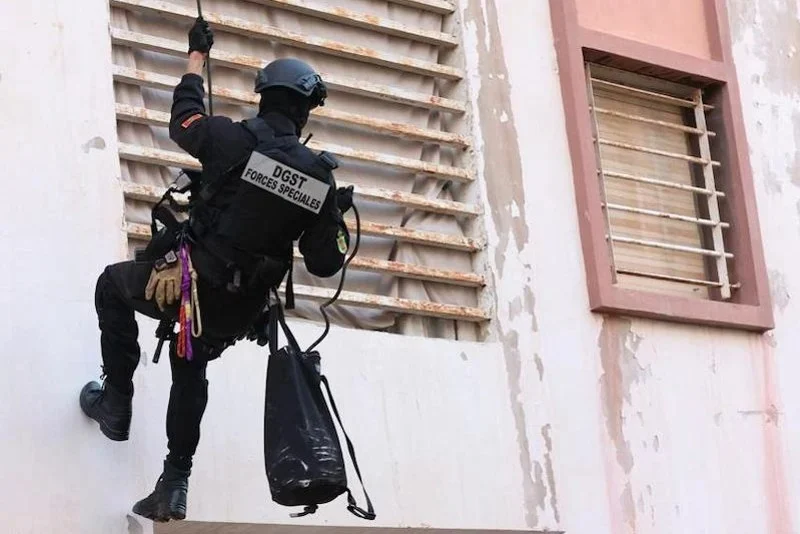
The operation, based on insights provided by the General Directorate of Territorial Surveillance (DGST), forms part of ongoing efforts to address the dangers of extremism and terrorist threats targeting the Kingdom’s security and the safety of its citizens, the BCIJ said in a press release.
Preliminary findings from the investigation, supported by security surveillance operations, revealed that the two suspects, both aged 19, had pledged allegiance to the so-called emir of the terrorist organization ISIS, and vowed to carry out imminent terrorist attacks as part of “lone wolf jihad” aimed at seriously undermining the safety of individuals, public order, and vital infrastructure, the press release specified.
Another ISIS-affiliated extremist, 22, was arrested last Tuesday in Dakhla. He had also expressed his intention to carry out terrorist plans to undermine public safety and public order.
This security operation led to seizing electronic devices and several bladed weapons of various sizes, as well as paramilitary uniforms.
The suspects have been taken into custody pending their transfer to the BCIJ to conduct a criminal investigation under the supervision of the Public Prosecutor’s Office responsible for terrorism cases, to determine the full extent of their extremist activities and to establish any possible links with various terrorist organizations.
In a comment on the preemptive operations carried out by Moroccan security services this week in the cities of Dakhla, Midelt, and Youssoufia, Hespress news outlet in Arabic pointed out that the operations revealed a significant shift in the nature of the terrorist threats facing the Kingdom, namely the rise of what is known as “individual jihad” or the “lone wolf phenomenon.”
The recent arrests of extremist individuals in these cities demonstrated that terrorist organizations, foremost among them ISIS, no longer rely primarily on coordinated cells, but increasingly depend on isolated individuals — psychologically and digitally detached — who receive incitement through virtual spaces and carry out low-cost attacks that are difficult to predict using traditional surveillance methods.
Observers emphasize that as terrorist threats enter a more complex phase, the Moroccan model stands out as an exceptional case in the region. Through a multilayered approach, Rabat has succeeded in dismantling the plots of these “lone wolves” before they turn into bloody acts, thereby establishing a distinct security doctrine that has made Morocco a strategic partner and an influential regional and international actor in exporting security expertise and confronting asymmetric threats that increasingly trouble even the world’s most advanced security and intelligence systems.