Morocco has reiterated its commitment to placing artificial intelligence (AI) at the center of the African debate, not from a purely technological perspective, but as a tool with direct implications for Africa’s stability, and as an implement that serves the continent’s peace, security, and sustainable development.
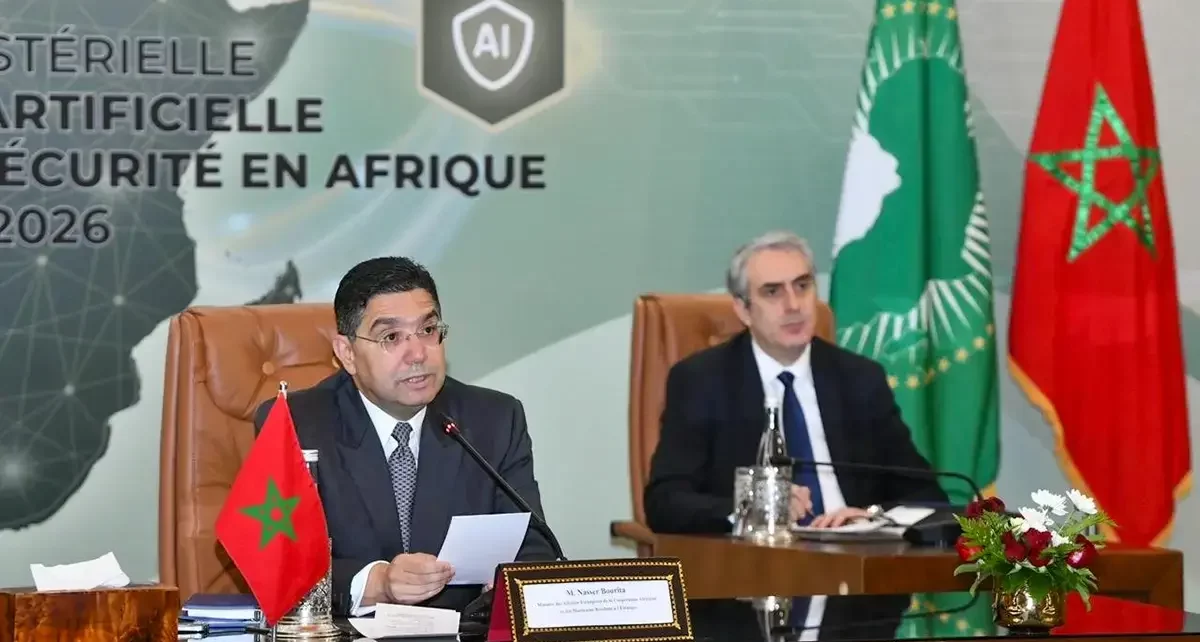
This came in the address delivered by Foreign Minister Nasser Bourita during the ministerial meeting of the African Union Peace and Security Council, held via videoconference, on Thursday.
The meeting was dedicated to Artificial Intelligence and its implications for governance, peace, and security in Africa.
Bourita recalled that this meeting did not start from scratch, as Morocco, on March 20, 2025, was the initiator of the first meeting of this body dedicated exclusively to AI. Since then, there have been some concrete advances, such as the adoption of a joint African declaration on AI and the idea – still under development – of a specific fund to finance technological development in this field, he said.
While emphasizing that Morocco’s commitment to making AI a strategic lever for sovereignty, development, and public action, the official praised ambitious continental initiatives, notably the establishment of an Advisory Group on AI, and reaffirmed the Kingdom’s full support for African actions aimed at ensuring equitable and sovereign access to this technology.
Beyond the announcements, the tone of the speech was marked by a certain caution. Bourita focused on the less visible effects of artificial intelligence, particularly as they relate to governance. The proliferation of manipulated content, he warned, is already altering the political landscape in various countries, eroding institutional trust in a silent yet constant manner.
He also touched upon how these technologies are beginning to be integrated into conflict dynamics. Not so much in their more obvious military dimension, but in their capacity to amplify hate speech or create tension within societies through the selective manipulation of information. A phenomenon that is difficult to track and even more complicated to contain.
At the same time, Bourita mentioned another, less striking but equally relevant problem: the growing complexity of peacekeeping operations. The overabundance of data, combined with new hybrid threats, is changing the rules of the game on the ground.
Faced with this scenario, Morocco proposes a response that blends ambition and pragmatism. On the one hand, it proposes creating African mechanisms capable of detecting and reacting swiftly to disinformation campaigns. On the other, it insists on the need to train specialized personnel within the continent and to reduce dependence on foreign technology.
The underlying idea is clear: if Africa does not develop its own tools, it will end up managing problems designed from outside. Hence the need to build local solutions, specifically designed for conflict prevention and support for peacekeeping missions, the Moroccan official insisted.
In the final part of his speech, Bourita returned to Morocco’s position in this area, mentioning initiatives such as ‘Digital Morocco 2030’ and ‘AI Made in Morocco’. Rather than presenting them as completed achievements, he framed them as part of a long-term strategy.
The message, in any case, was consistent with the rest of the speech: artificial intelligence is not just a matter of innovation, but of political balance, security and autonomy in an increasingly competitive context.