Morocco’s organization of the 2025 Africa Cup of Nations (AFCON) has drawn widespread praise from the Confederation of African Football (CAF), international media and sports observers, as the tournament sets new records.
All went well, except a brief moment in the final in Rabat when Senegalese coach, players and some fans showed a lack of sportsmanship and threatened to leave the pitch following a VAR-awarded penalty that was missed by Atlas Lion Brahim Diaz.
The Atlas Lions ultimately fell short in the final, losing 1–0 after extra time to Senegal. Official tournament records list Morocco as runners‑up, with Senegal securing their second continental title. Morocco nonetheless received the Fair Play Award, and Moroccan forward Brahim Díaz finished as the tournament’s top scorer with five goals.
CAF described AFCON 2025 as the most commercially successful tournament in the competition’s history, citing a surge to 23 sponsors, more than double the number secured in 2022 and an increase from 17 in 2023.
The organization credited Morocco’s heavy investment in sports infrastructure, including upgrades to stadiums in Rabat, Tangier, Agadir and Marrakech, for creating a premium environment that attracted major global partners;
In a separate statement, CAF emphasized Morocco’s “proven capacity” to deliver world‑class tournaments, referencing the country’s track record with events such as CHAN 2018, WAFCON 2022 and the FIFA Club World Cup 2023.
The body stated that Morocco’s readiness and infrastructure “set the stage for what could be one of the most memorable editions of the Africa Cup of Nations.”
Morocco advanced to the final after a string of solid performances, including wins over Comoros, Zambia, Tanzania, Cameroon and Nigeria in the semifinals.
Overall attendance reached 1.34 million spectators, an average of 25,770 per match, reinforcing CAF’s characterization of the event as a landmark edition.
Morocco entered AFCON 2025 with nine international‑standard stadiums prepared across six host cities, an infrastructure program completed in under three years and described as one of the most ambitious in tournament history.
All nine venues were upgraded or newly built to meet CAF and FIFA standards, featuring hybrid pitches, redesigned seating bowls, improved security systems, and advanced broadcast technology.
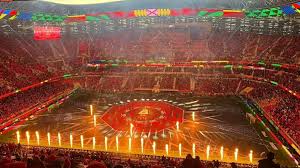
Notably, Rabat emerged as the central hub with four major stadiums, including the rebuilt Prince Moulay Abdellah Sports Complex, a 69,500‑seat facility inaugurated in September 2025 and designated to host the opening match and the final.
The tournament was a showcase for Morocco’s investments in iconic arenas such as the Grand Stade de Tanger (75,600 seats), the country’s largest stadium, and Casablanca’s Mohammed V Complex, long considered one of Africa’s most atmospheric football grounds. These stadiums combine modern engineering with cultural motifs, many removing athletics tracks to create football‑specific environments, an upgrade aligned with Morocco’s preparations for co‑hosting the 2030 FIFA World Cup.