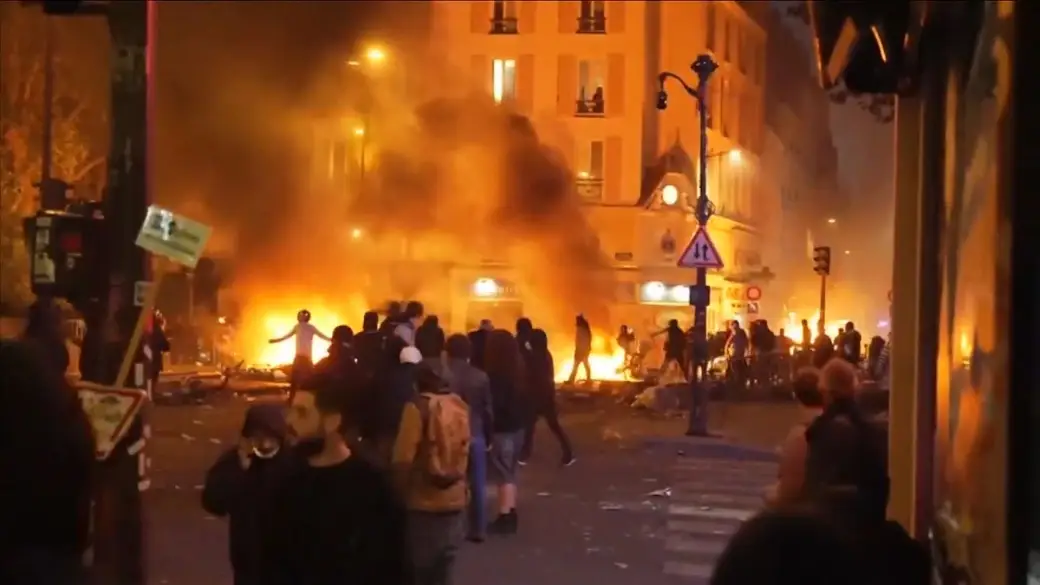
Widespread violent protests, rioting, and looting erupted over the weekend across France, driven by public anger over the rising cost of living, inflation, underfunded schools, and planned government budget cuts.
The explosive situation is deepening the crisis President Emmanuel Macron is facing during the country’s worst riots in decades. Shocking videos show department stores and independent shops ransacked and vandalized across several French cities after government buildings were torched and violent clashes between the protesters and the police.
Riot mayhem comes after weeks of student protests broadened to a wider movement of people angry over the rising cost of living. In Marseille, rioters used a metal barricade to ram through the door of city hall, allowing a crowd of young masked people to storm the building and graffiti its lobby.
In Lyon, the city’s office of tourism was set ablaze and stores were vandalized marched. In Paris, rioters torched cars and blocked the streets with burning barricades.
Security forces scrambled to reinforce the area around the Élysée Palace and other sensitive sites after protesters sought to converge on government buildings, according to French officials. In Limoges, a town in central France, the 19th -century City Hall was set ablaze, causing its roof to collapse and nearly destroying the building.
At least 2,400 people were arrested on Saturday after protests against the soaring cost of living and poor school conditions descended into violent unrest.
In an emergency address from the Élysée Palace on Sunday evening, French President Emmanuel Macron appealed for calm and warned that public gatherings would be banned to halt the rioting if necessary.
Macron echoed other government officials in blaming much of the violence on far-left activists, accusing them of attacking police and public buildings to foment chaos.
Laurent Nuñez, France’s interior minister, admitted on Monday that police had “lost control” of the riots in several cities after 60,000 police and gendarmes were deployed.
Political leaders traded accusations over Saturday’s violence ahead of next spring’s presidential election. Far-right leader Marine Le Pen criticized Macron’s centrist government as “exhausted, disoriented and seemingly incapable of doing anything other than commenting on its own powerlessness,” in a video posted on social media.
Far-left contender Jean-Luc Mélenchon accused Prime Minister Sébastien Lecornu of “playing with fire,” alleging that “by banking on degradation, you have only succeeded in uniting all youths and workers’ unions.”
U.S. President Donald Trump said “France is burning!” on his Truth Social platform, apparently linking the unrest to “the immigration of people from an entirely different world.” But French authorities and police have not blamed immigration for the mayhem.
The chaos and violence protests have spooked investors in France’s government debt, triggering a wave of selling of its bonds on the stock markets.
France’s debt-to-GDP stood at 115.6% in 2025, while its budget deficit was 5.1%. The French government is currently preparing a budget that would involve cutting pensions spending and funding for government departments, excluding defense.
However, there are growing fears that political pressure could derail these plans, which could push up more borrowing and add more to the country’s national debt which has reached a record $4 trillion.
Student protests over education resources and public resentment over rising living costs are adding pressure as lawmakers weigh spending choices ahead of the 2027 presidential election.
According to experts, the euro zone’s second-biggest economy is heading toward a debt crisis, and risks dragging the continent down with it, unless it sustainably brings down its national deficit.