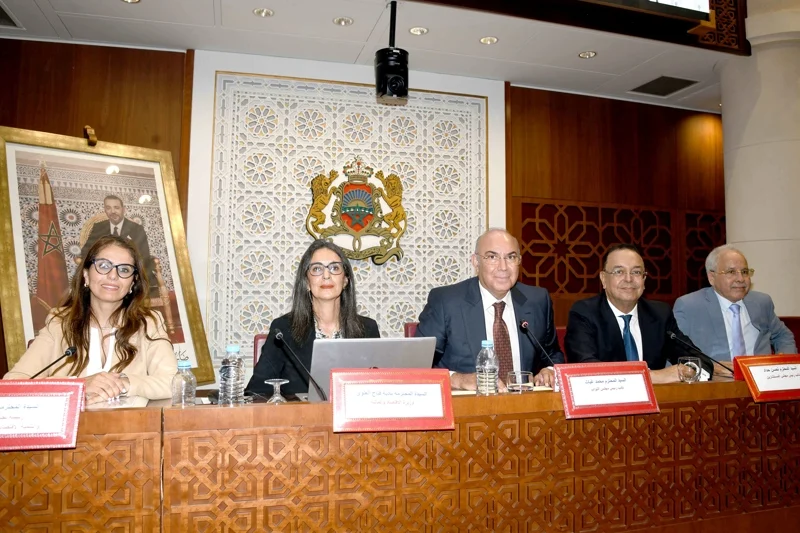
Morocco’s Minister of Economy and Finance, Nadia Fettah, presented parliament with an update on the execution of the 2026 budget law and the government’s fiscal roadmap for 2027-2029, built around three themes: the economic outlook, the state of public finances at mid-year, and budget priorities for the next three years.
The government now expects growth of 5.3 percent in 2026, 0.7 points above the 4.6 percent assumed in the original budget law, driven largely by an agricultural rebound: farm value added is projected to rise 15.1 percent, with non-agricultural activity growing 4.2 percent. Fettah attributed the revision to the recovery of agriculture after years of drought, alongside investment and domestic demand, while flagging external risks tied to the Middle East conflict, energy markets and commodity volatility. The government’s forecast is slightly more optimistic than both the HCP’s (4.8 percent) and the central bank’s (5.2 percent).
Inflation is expected to stay contained, averaging 0.5 percent over the first five months of 2026 after 0.8 percent in 2025, with the government projecting 1.5 percent for the full year and 2 percent in 2027. Ordinary revenues rose 15.4 percent, with a 52 percent execution rate; corporate tax collection jumped 26.2 percent, income tax rose a more modest 1.9 percent due to a base effect from an exceptional 2025 regularization payment, and domestic VAT climbed 5.8 percent.
The budget deficit stood at 24 billion dirhams at the end of June, an improvement of 6.7 billion dirhams year-on-year and equivalent to 43.2 percent of the full-year target, aided by a surplus in special Treasury accounts. The ministry expects the annual deficit to hold at 3 percent of GDP, in line with the original budget law. Treasury debt stood at 66.6 percent of GDP at the end of 2025, down a cumulative 5.6 points since 2020; by the end of June 2026, domestic debt reached 862.3 billion dirhams and external debt 327.8 billion dirhams, with an average maturity of about eight years, which the government describes as evidence the debt is “controlled and sustainable.”
For 2027-2029, budget priorities will center on consolidating Morocco’s “social state” — extending social protection, reforming health and education, and supporting territorial development — alongside productive investment, business climate improvements, support for small and micro enterprises, and major sectoral projects spanning water security, transport infrastructure, digital transformation and energy transition. The ministry forecasts growth of 4.1 percent in 2027 and an average of 4.2 percent over 2028-2029, cautioning that these projections remain subject to global uncertainty, geopolitical tensions and climate-driven volatility in commodity markets.