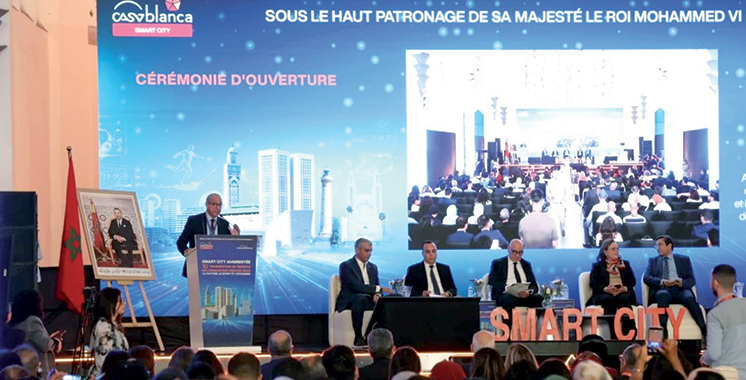
The 10th edition of Casablanca Smart City, held under the theme of the Augmented Smart City, placed entrepreneurship, urban creativity, and the mobilization of talent at the center of its second day of proceedings. Over ten editions since its launch in 2016, the event has brought together more than 42,000 participants, 685 exhibitors, 661 speakers, and delegations representing 181 cities worldwide, establishing itself as one of Africa’s leading platforms for territorial innovation and urban intelligence.
Several speakers addressed the conditions needed for a genuinely entrepreneurial city to take shape. Lamia Benmakhlouf, Director General of Technopark, presented the ecosystem model developed at the Casablanca tech campus, which operates through structured cooperation between universities, financing structures, and public and private sector actors. She noted that 35 percent of resident startups now export their solutions internationally, underscoring the transition from domestic incubation to global reach. Imane Belmaati, president of Human Impact Hub, argued that smart cities must evolve beyond infrastructural programs to become genuine platforms for youth employability and enterprise, calling for improved convergence between public, private, and associative initiatives alongside more adapted mechanisms for financing high-impact projects.
The event also served as a platform for international experience-sharing. Marc Liew, representing Singapore Cooperation Enterprise, presented the Punggol Digital District model — an integrated ecosystem in which a university, startups, incubators, investors, and public institutions share a single innovation space and operate on the basis of pooled data, skills development, and collaborative governance. Isabelle Ferrer, Vice-President of Toulouse Métropole, described the campus-based approach developed for sectors including aeronautics, decarbonized mobility, health, and artificial intelligence, designed to create sustained bridges between enterprises, research centers, and startup communities.
Abraham Badji, representing the city of Dakar, presented a concrete case study: the digital Set Wash project, which formalizes the activity of vehicle washers operating in the informal sector, generating measurable water savings, employment creation, and social integration. The example illustrated how digital tools can serve urban inclusion goals alongside efficiency objectives.
The 10th edition was framed explicitly within the context of Morocco’s accelerating preparations for major international sporting events, most notably the 2030 FIFA World Cup, which both organizers and speakers treated as a catalyst for urban modernization and international visibility. The thematic program spanned digital innovation, smart governance, digital inclusion, citizen participation, and urban quality of life — connecting immediate entrepreneurial priorities to the longer-term vision of competitive, livable, and internationally connected Moroccan cities.