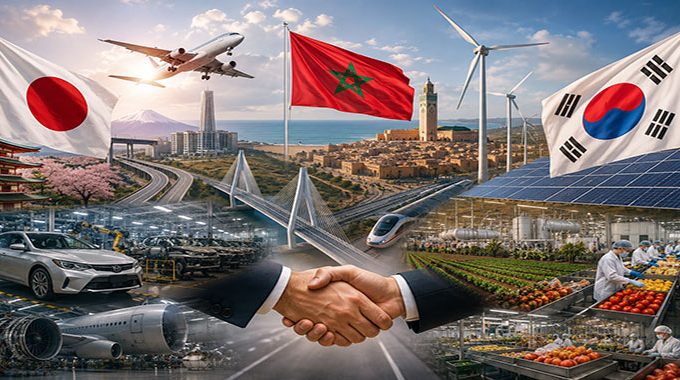
Morocco finds itself at the center of a quietly intensifying competition between two East Asian economic powerhouses — Japan and South Korea — each moving rapidly to deepen political, industrial, and commercial ties with the Kingdom, with Africa as the strategic backdrop, stated Aujourd’hui le Maroc in an article published Monday. Within a matter of weeks, both Tokyo and Seoul have produced a series of concrete diplomatic and commercial initiatives that signal a deliberate reassessment of Morocco’s importance in their respective foreign economic strategies.
Japan’s moves have been both symbolic and operational. Two weeks ago, Tokyo officially endorsed Moroccan autonomy under Moroccan sovereignty and committed to acting on that position at both diplomatic and economic levels — a statement signed by Foreign Ministers Nasser Bourita and Motegi Toshimitsu at a videoconference marking the 70th anniversary of bilateral diplomatic relations. Days later, Takako Tsujisaka, Deputy Director-General for International Trade Policy at Japan’s Ministry of Economy, Trade and Industry (METI), visited Morocco for discussions on strengthening the industrial and economic partnership — a working-level mission that signals the translation of political intent into commercial planning. Japan has simultaneously announced its intention to lift longstanding arms export restrictions — a historic reversal of its post-war pacifist posture that opens the door to defense industrial cooperation, the daily recalled.
South Korea’s engagement is proceeding on a parallel track. Seoul and Rabat have formally agreed to accelerate negotiations for a Comprehensive Economic Partnership Agreement (CEPA), announced by Trade Minister Yeo Han-koo and State Secretary Omar Hejira in a video conference. Korean officials are moving with urgency: Ambassador Yoon Young-jin simultaneously received a delegation from the Korean Customs Agency to advance cooperation on customs procedures and facilitate Korean business activity in Morocco. Korea and Japan share strong industrial profiles in mobility, energy, nuclear technology, desalination membranes, and defense — sectors that align precisely with Morocco’s strategic infrastructure needs for the next decade.
The competitive dynamic between the two is not lost on Moroccan policymakers. Japan’s firms have been embedded in Morocco for decades across automotive, electronics, and construction, but are facing growing competition from Korean companies in sectors like automobile manufacturing, where Hyundai Rotem just won the ONCF rolling stock contract, and in battery and green hydrogen technology. The CEPA negotiation, if successfully concluded, would give South Korean exporters a preferential access framework comparable to what Japanese companies have enjoyed through long-standing commercial presence.
The broader context is the reconfiguration of global industrial supply chains. Both Japan and South Korea are seeking to reduce their China dependency and build reliable partner networks in politically stable, strategically located countries. Morocco — with its free trade agreement with the United States, its Association Agreement with the EU, its Atlantic-African geography, its World Cup 2030 infrastructure pipeline, and its growing industrial sophistication — is increasingly visible on the strategic maps of both Tokyo and Seoul as a preferred partner node in a diversifying world order.