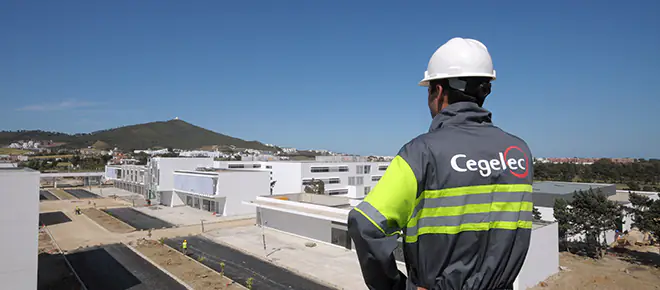
Moroccan engineering firm Cegelec has secured a contract worth more than two billion dirhams to design and construct a suite of high-voltage electricity transmission and generation assets in Guinea, the company announced this week. The project, carried out through its subsidiary VINCI Energies Guinée, was launched officially on April 18 at Kamissaya in the prefecture of Kindia, in the presence of Guinea’s Prime Minister Amadou Oury Bah and two senior ministers.
The contract covers the construction of extra-high-voltage transmission lines and substations, as well as a 50-megawatt-peak solar photovoltaic power plant complete with its grid evacuation substation. The combined infrastructure is designed to reinforce and stabilize the Guinean national grid, increase generation and transmission capacity, and support the country’s integration of renewable energy into its national energy mix.
For Cegelec, the contract is the latest in a sustained expansion across Sub-Saharan Africa and the wider region. The firm has previously completed major electricity infrastructure projects in Benin, Côte d’Ivoire, Mauritania, Senegal, and Rwanda, and has delivered high-voltage substations and transmission lines in Kuwait and Saudi Arabia. This track record positions it firmly as a reference contractor for turnkey energy infrastructure on the African continent.
Abdellah Sabri, Director General of Cegelec and VINCI Energies Africa, described the Guinea project as grounded in a commitment to local human capital development. The contract explicitly provides for structured technology transfer at each stage of execution, with Guinean teams given the opportunity to acquire competencies in high-voltage transmission and solar energy systems — skills the company frames as strategically important for the host country’s long-term energy autonomy.
The award underscores the growing commercial reach of Morocco’s engineering and industrial services sector. Cegelec, a subsidiary of VINCI Energies, operates as a fully Moroccan-headquartered entity and has built a diversified portfolio spanning energy infrastructure, industrial installations, and digital systems. Its ability to compete for and execute multi-billion-dirham contracts across multiple continents is indicative of the maturity that Morocco’s engineering industry has achieved over the past two decades.