Morocco’s long‑term investment in strategic port infrastructure has taken on renewed significance as global supply chains face mounting disruption and major economies move to assert tighter control over maritime gateways.
In a world marked by geopolitical rivalry, fragile logistics and growing scrutiny of foreign influence, ports have become instruments of sovereignty, resilience and economic security.
Few countries anticipated this shift as early as Morocco. Guided by the vision of King Mohammed VI, the Kingdom began modernizing and expanding its port network in the early 2000s, well before global tensions exposed the vulnerabilities of international trade routes.
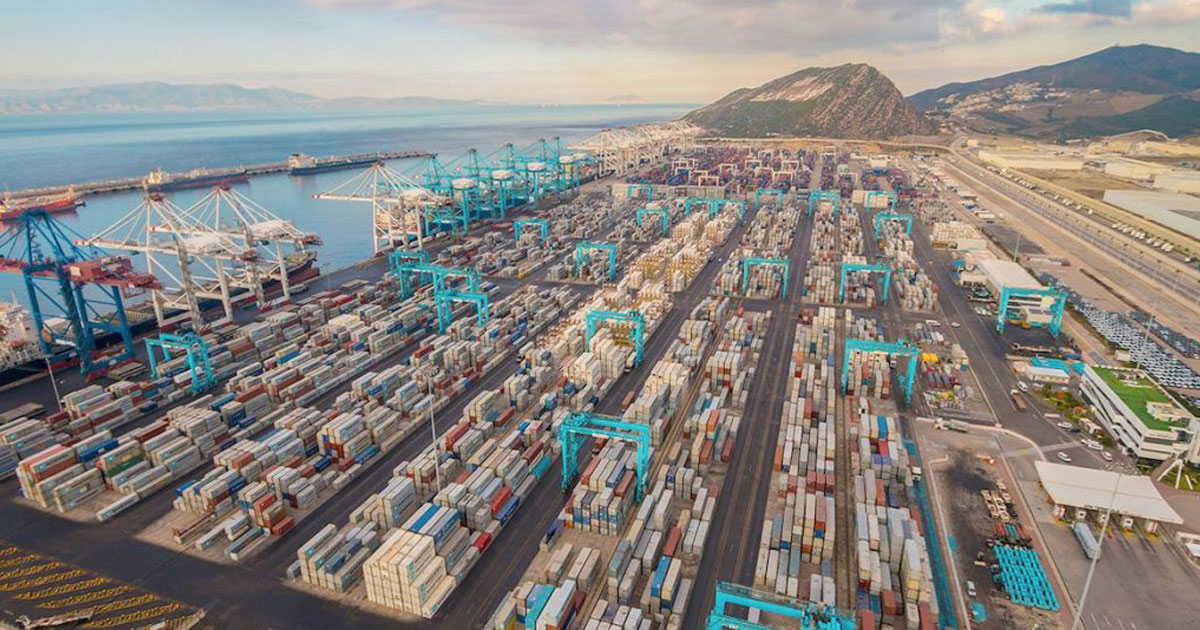
The launch of the Tanger Med complex in 2003 marked a turning point. At the time, the King described the port as “the nucleus of a major port, logistical, industrial and commercial complex”, positioning Morocco as a bridge between Europe and Africa, and between the Mediterranean and the Atlantic.
Two decades later, that strategy is proving decisive. Ports handle 98% of Morocco’s external trade, and Tanger Med has become one of the world’s leading transshipment hubs, connecting the country to 180 ports in 70 countries.
Its scale and efficiency have strengthened Morocco’s industrial expansion while reducing dependence on foreign gateways for energy, food and raw materials.
The strategy has since been expanded through two additional megaprojects: Nador West Med, set to enter service in late 2026, and Dakhla Atlantique, due to start operations in 2029. Nador West Med represents 51 billion dirhams in public and private investment and will ultimately offer more than 5 million TEUs of container capacity, as well as Morocco’s first LNG terminal and major hydrocarbon storage facilities. Dakhla Atlantique, already over 53% complete, will anchor Morocco’s Atlantic logistics corridor, with commercial, fisheries and repair basins designed to support regional and transatlantic trade flows.
Globally, the strategic relevance of ports has risen sharply. The European Union has tightened monitoring of foreign ownership in critical port infrastructure and adopted new mechanisms to reinforce security, resilience and dual‑use capabilities.
Panama’s decision to reclaim control of its Balboa and Cristobal terminals from a foreign operator illustrates a wider trend: national authorities asserting control over logistics assets seen as vital to economic and security interests.
In this context, Morocco’s early investment in sovereign, globally competitive ports appears increasingly prescient. Tanger Med, Nador West Med and Dakhla Atlantique now form the backbone of a national logistics architecture designed not only for economic growth but for strategic autonomy in a rapidly shifting global landscape.