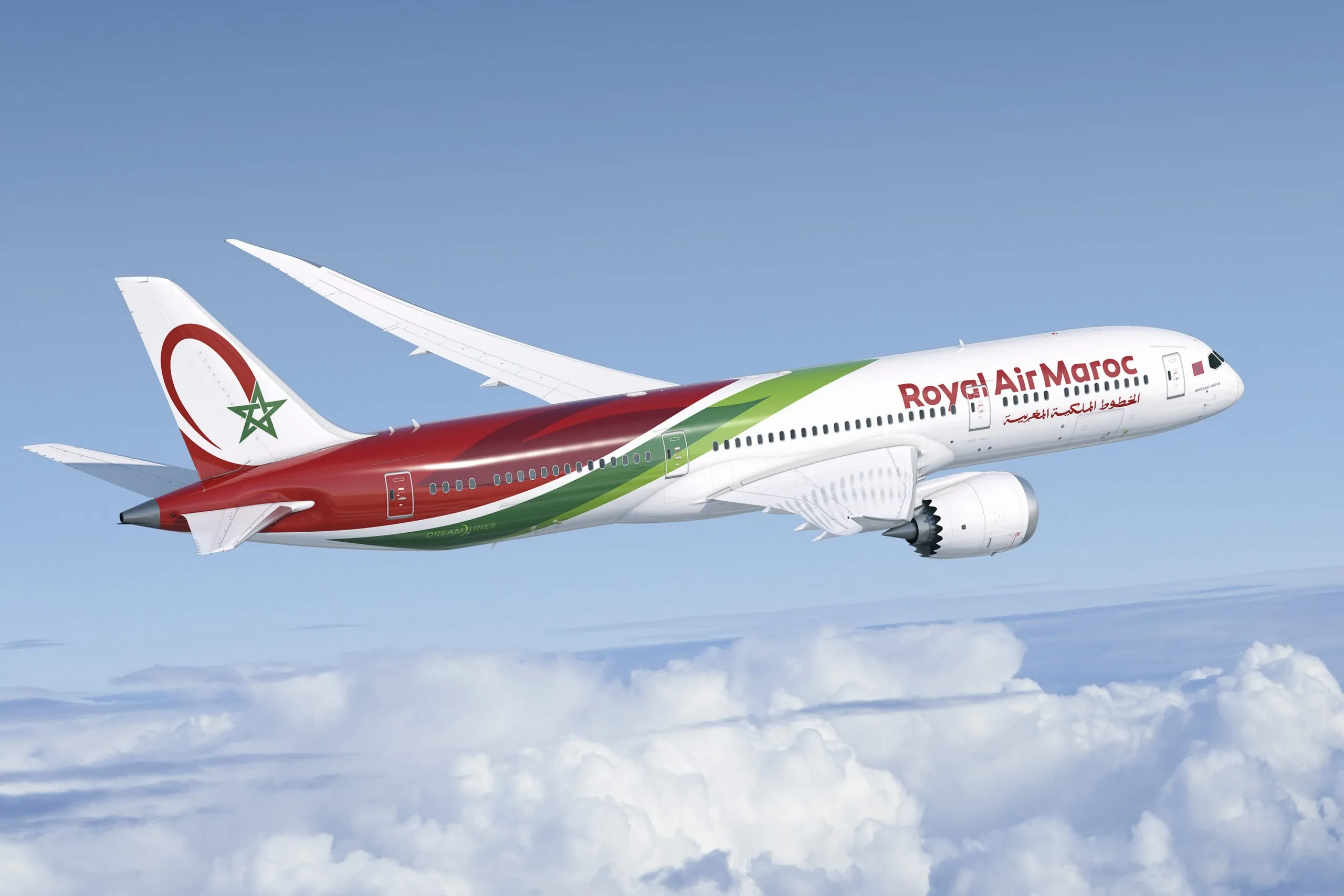
Less than two years after its return to the South American market, Royal Air Maroc (RAM) has reached a new milestone with the launch, on Thursday, of its fifth weekly direct flight between São Paulo and Casablanca.
The national carrier is planning daily flights from the Brazilian metropolis by 2028 and to launch a new route to Rio de Janeiro, another Brazilian city, by the end of 2027, Moroccan media reported.
This expansion falls fully in line with RAM’s global growth plan, with the aim of bolstering presence in Brazil while offering enhanced connectivity to more than 100 destinations across Africa, Europe, the Middle East, America, and Asia.
Operated by a Boeing 787-9 Dreamliner, this new service responds to rapidly growing demand and anticipates the start of the European winter season, a strategic period for Brazilian tour operators and travel agents.
Flights departing from São Paulo are now scheduled for Tuesdays, Wednesdays, Thursdays, Fridays, and Sundays, while flights from Casablanca operate on Mondays, Tuesdays, Wednesdays, Thursdays, and Saturdays.
This commercial momentum is supported by strong performance metrics. In 2025 alone, the route connecting São Paulo to Casablanca carried approximately 80,000 passengers in both directions, posting an average load factor of 84% and an impressive on-time performance rate of 98%.
This upward trajectory also aligns with the growth of domestic tourism. Morocco welcomed a record 19.8 million international tourists in 2025, including 60,000 Brazilian visitors, a 35% increase over the previous year.
The expansion of this air service also supports the major infrastructure and urban mobility projects undertaken by Morocco in preparation for co-hosting the 2030 World Cup alongside Spain and Portugal.
RAM, a member of the global oneworld alliance and rated four stars in the international Skytrax rankings, is undergoing a major expansion aimed at cementing its status as an intercontinental airline.
Its 2023-2037 strategic plan calls for expanding its fleet to 200 aircraft, with a long-term goal of carrying 32 million passengers per year, up from 7.5 million in 2024. This growth is accompanied by a firm commitment to sustainability, exemplified in 2025 by its first flight powered by sustainable aviation fuel (SAF).