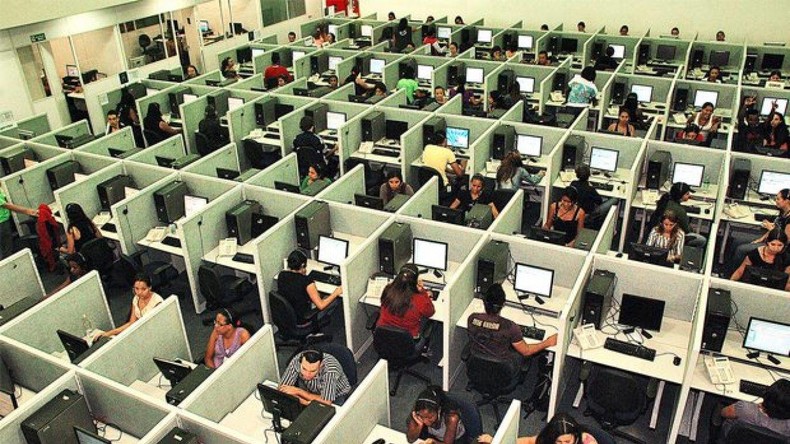
Three weeks after France’s ban on unsolicited telephone canvassing took effect, Morocco’s call center sector is still struggling to measure its impact, though early signs are already visible in Casablanca, where some companies have taken down their signage and a Technopark call center has closed, leaving 50 employees without jobs, Le360 reports.
Ayoub Saoud, secretary general of Morocco’s National Federation of Call Centers and Offshoring Professions, said the French law took effect August 11 in the middle of the summer holiday period, when most telemarketing firms were on annual leave, making it too early to draw firm conclusions though the first effects should become visible with the return to work.
Saoud said the sector’s informal structure, with many small firms failing to formally declare employees, makes precise job-loss figures nearly impossible to establish, and reported that the Federation has drafted a memorandum for the government aimed at anticipating and cushioning the impact of the regulatory and technological shifts under way.
He noted artificial intelligence is compounding the pressure, citing a recent audit firm study that found AI-linked headcount reductions in France for the first time. He also warned of a repeat of a May 2025 case in Casablanca, where an employer closed a call center overnight, leaving roughly sixty employees without recourse despite winning their case in court.
The picture looks different at the Moroccan Federation of Outsourcing and Shared Services (FMES), whose president, Youssef Chraibi, ruled out any destabilization of the sector. He said the French measure targets only unsolicited commercial prospecting, which represents a minority share of Morocco’s overall outsourcing activity and less than 15 percent of contact-center work, since the sector now spans inbound customer relations, back-office, BPO, digital services, IT and AI. Chraibi put the total impact so far at around 10,000 jobs out of the sector’s 150,000, against more than 15,000 jobs created annually, meaning net job creation should hold.
Chraibi said operators had time to prepare, gradually redirecting volumes toward other activities rather than facing sudden cuts, and that the real question is whether the sector as a whole keeps generating activity and employment.
At Outsourcia, the company he leads, he said exposed activities were identified in advance and staff redeployed to other units, with no site closures linked to the French reform. He argued Morocco’s outsourcing future lies increasingly in more complex, digitalized services combining technology, AI and human expertise, rather than in preserving telemarketing as it has traditionally existed.