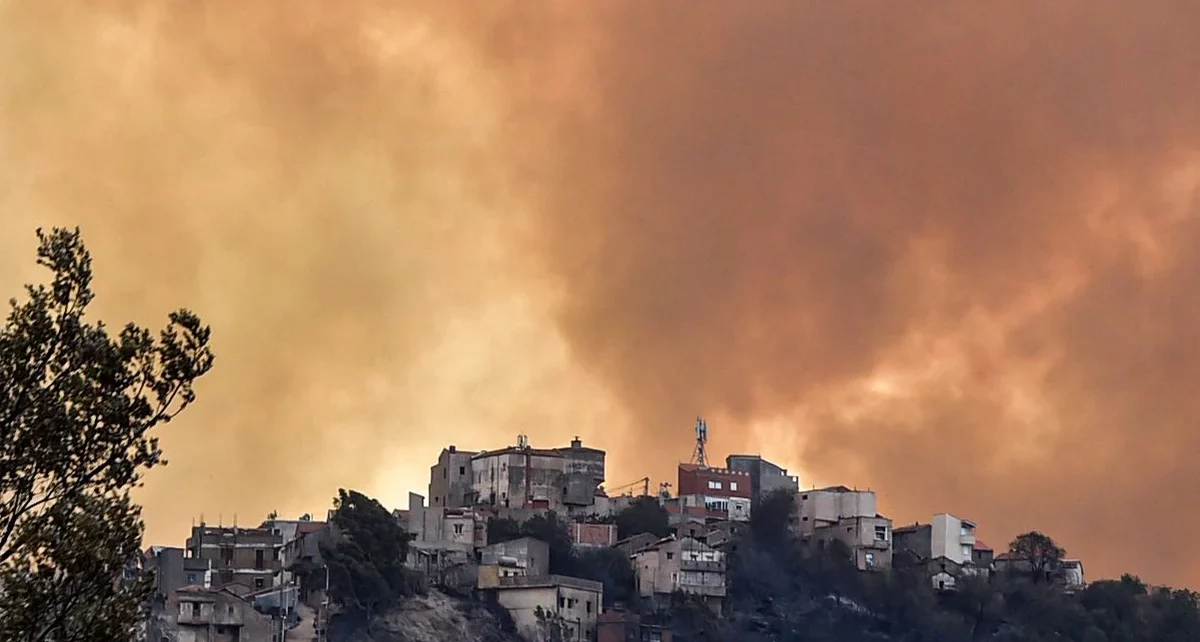
Algeria is once more in national mourning after deadly wildfires claimed at least 12 lives and injured dozens this week.
President Abdelmadjid Tebboune declared three days of mourning, with flags at half-mast and public festivities cancelled.
The latest toll – five dead in Jijel, four in Béjaïa and three in Tizi Ouzou – is believed to be below the scale of the wildfires, as the government has a long history of manipulating figures.
The deadly wildfires are only the most recent chapter in a recurring tragedy. Instead of anticipating such catastrophes, the regime prefers to look elsewhere as it continues to fail its citizens while pouring record sums into military hardware.
Algeria, which lacks water-bombers such as the potent Canadairs, has spent $25.4 billion on defense in 2025, the highest military budget in Africa and nearly half the continent’s total defense expenditure, according to the Stockholm International Peace Research Institute.
Much of that money has gone into Russian-origin equipment, such as combat aircraft, attack helicopters, air-defense systems and other heavy weaponry.
Yet year after year, when northern forests burn, Algerians are left confronting walls of flame with limited aerial firefighting capacity.
President Tebboune’s 2021 televised pledge to acquire water-bomber aircraft after that summer’s fires killed more than 69 people (including dozens of soldiers) remains largely unfulfilled in the form of a robust, dedicated Canadair-type fleet.
Neighboring Morocco, which spends a fraction of Algeria’s military budget, has operated a fleet of Canadairs for years and regularly deploys them to help other countries. Algeria, by contrast, still struggles to field an equivalent independent amphibious water-bomber capability capable of rapid, sustained response across its mountainous northern regions.
Algerian resources that could have purchased modern firefighting aircraft, trained specialized crews, and built a resilient civil-protection fleet have instead been directed toward expanding an already large arsenal of Russian military equipment.
The same pattern of negligence was already visible earlier this summer. In mid-July, a fire at a foster care facility (orphanage) in Mohammadia, on the outskirts of Algiers, killed 11 people, including children, and injured 19 others.
The blaze was reportedly sparked by a faulty air-conditioning unit during a heatwave. The tragedy triggered public shock and demands for accountability, yet it quickly faded from official attention, another reminder that basic safety and prevention remain secondary priorities in gas-rich Algeria.