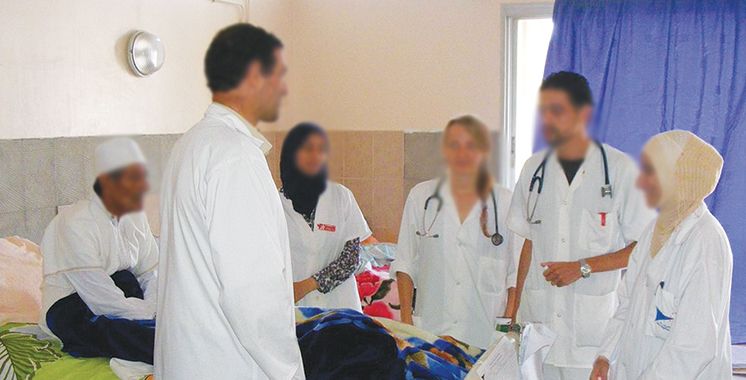
Health Minister Amine Tehraoui announced before the Chamber of Representatives on Monday that approximately 530 newly graduated specialist physicians will be positioned at hospitals across Morocco’s regions from the date of their graduation, beginning in August 2026. The announcement marks what the minister described as a historically unprecedented acceleration of deployment, ending a system in which delays of up to two years between graduation and posting had been structurally embedded in the assignment process — a dysfunction that had deprived the public health system of qualified specialists precisely at the moment they were most ready to practice.
The measure is enabled by a new regulatory framework introduced through the decree governing the status of medical, pharmacy, and dental students, which extends compulsory contractualization with the state to all newly qualified specialists. Under this system, every new specialist will be required to complete a mandatory service period in public health establishments after graduation: four years for the 2026 and 2027 cohorts, three years from 2028 on. This provision, Tehraoui emphasized, breaks with a situation that had persisted for 33 years and guarantees that the entire cohort of newly qualified specialists contributes to the public health service during a critical phase of their professional formation.
The scale of the reform is also visible in the numbers: approximately 2,000 residency positions were opened this year under the new system. These residents will join public health establishments beginning in 2030 as a structural pillar of the Groupements Sanitaires Territoriaux (GST) — the territorial health groupings that constitute the central governance reform of Morocco’s health restructuring agenda.
The GSTs will, for the first time, play a central role in organizing, supervising, and assigning residents, as well as in structuring their training pathways and clinical rotations. This integration allows training to be aligned with the actual health needs of each region and with both national and regional health maps — moving Morocco away from a centralized assignment model that frequently produced geographic mismatches between specialist availability and population health burden.
The August 2026 deployment is thus simultaneously a staffing measure, a reform of the contractual relationship between the state and its medical graduates, and a structural step toward making the GSTs operationally credible. For a health system that has historically struggled with specialist shortages in secondary cities and rural provinces, the combination of rapid deployment and multi-year public service obligation represents the most direct attempt in a generation to address the geographic distribution of medical expertise.