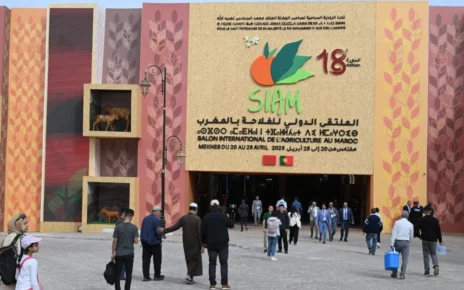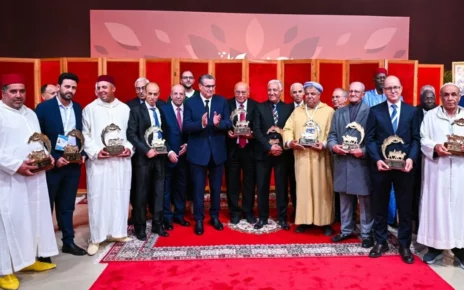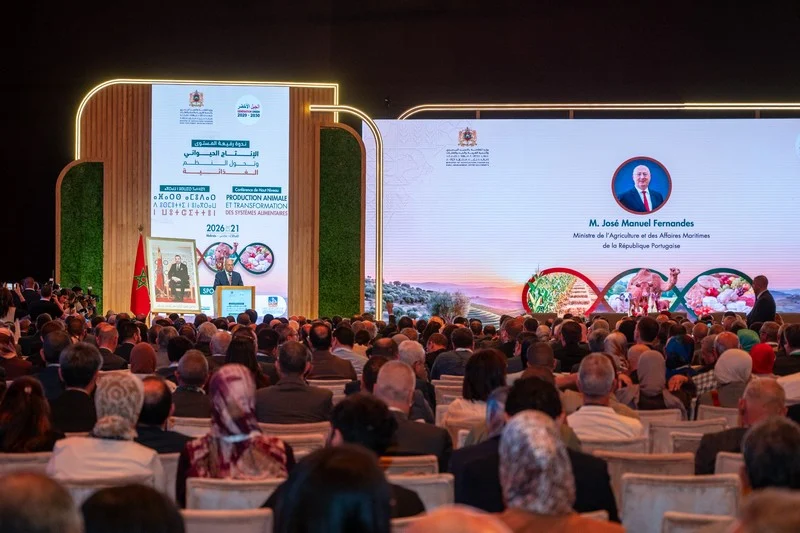
The 6th annual Ministerial Conference of the “AAA” initiative (Adaptation of African Agriculture), held on Wednesday in Meknes on the sidelines of the 18th International Agriculture Show in Morocco (SIAM), concluded with the adoption of a Declaration meant to boost climate-resilient Agriculture.
Aware of the urgency, and following up on the resolutions of COP30 while looking ahead to COP31, the Ministers of Agriculture and representatives of international and regional institutions, adopted the Declaration which covers six main commitments.
In this vein, they endorsed the concept note of the strategic document “10 Years of the AAA Initiative: Review and Vision 2036” and welcomed its development by the AAA Initiative Foundation in partnership with the FAO.
Regarding increased mobilization of climate financing, they called for the effective implementation of the NCQG (New Collective Quantified Goal) and for achieving the collective ambition of $1.3 trillion annually.
“We call for simplified, fair, and transparent access to funds dedicated to loss and damage, and for reform of the Green Climate Fund and the Adaptation Fund to better serve African realities,” stated the Declaration signatories.
They encouraged he development of innovative African mechanisms (climate bonds, green taxation, blended finance) to accelerate investment in resilient agriculture.
Regarding the finalization of NDCs (Nationally Determined Contributions) 3.0 and National Adaptation Plans, to date, 21 African countries have submitted their NDC 3.0.
In this context, they commit to collectively accelerating the finalization of their NDC 3.0 and National Adaptation Plans by COP31, systematically integrating concrete and quantified agricultural adaptation measures—agroecology, climate-smart agriculture, agroforestry, sustainable soil and water management, and nature-based solutions—while ensuring alignment with the Global Goal on Adaptation.
On another front, they affirm that food security in Africa requires priority support for small-scale producers, women, and youth, who are on the front line of climate impacts, calling for easier access to financing, innovation, inputs, markets, as well as agricultural insurance and social protection adapted to climate risks—subsectors currently largely under-covered by African NDCs.
At the same time, they commit to investing in early warning systems based on modern digital infrastructure. They actively support the International Platform on Adaptation Metrics (IPAM), led by the AAA Initiative Foundation, to support the implementation of the Abu Dhabi–Belém Program.
This platform will develop robust methodologies and indicators tailored to African agricultural realities, to ensure rigorous assessment of progress and strengthen the credibility of their actions.
As regards strategic partnerships, the officials reaffirm their commitment to strengthening intra-African and international cooperation. They likewise call for ambitious public-private partnerships and for intensifying South-South and triangular cooperation, welcoming synergies with the FAST Partnership, the Africa Adaptation Acceleration Program (AAAP), the Abidjan Initiative, and the three African Climate Commissions from the Marrakech Summit—Congo Basin, Sahel Region, and Island States—to advance a coherent and ambitious continental strategy.
Ten years after its launch, the AAA Initiative has established itself as a strategic lever for transforming African agriculture in the face of climate change. In this momentum, Ministers of Agriculture and representatives of international and regional institutions commit to mobilizing their full political will to achieve modern, inclusive, resilient, and high-performing agriculture, capable of feeding populations, preserving resources, and supporting territorial prosperity.
On the eve of COP31, and in view of the Rome event on September 16, 2026, they reaffirm their commitment alongside the United Nations Framework Convention on Climate Change and call on the international community to honor its commitments with ambition and solidarity.
On the same occasion, the officials praised the ongoing efforts of the Kingdom of Morocco and the visionary commitment of King Mohammed VI in favor of sustainable, inclusive, and sovereign African agriculture.