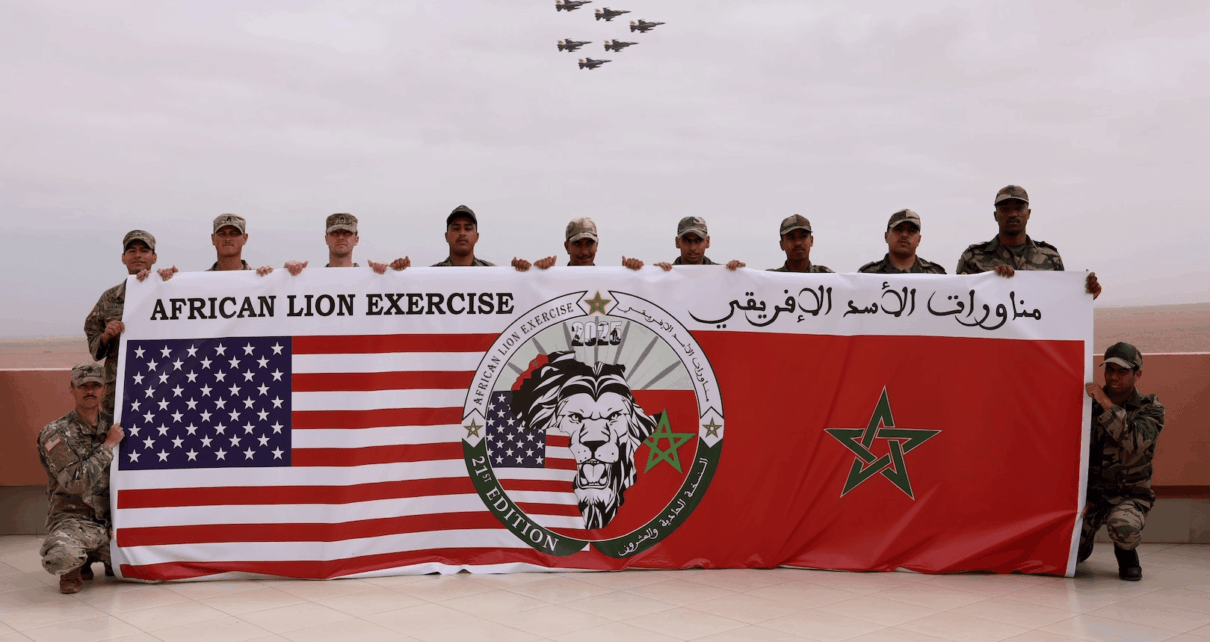
The US-led multinational African Lion military exercise planned this year in Morocco from April 20 to May 08, 2026 will focus on future warfare technology, innovation and artificial intelligence.
More than 40 technology firms will test cutting-edge military capabilities alongside U.S. military forces to close the gap between emerging innovation and the war-fighter in Morocco during AL- 26, says U.S. Army Southern European Task Force, Africa’s (SETAF-AF) Advanced Capabilities Directorate.
“Our ultimate purpose is to translate the senior leader’s vision for transformation into tangible, battlefield-ready capabilities in the hands of our Soldiers,” said U.S. Army Lt. Col. Ramon Leonguerrero, innovation division project manager for ACD.
African Lion, U.S. Africa Command’s largest annual training exercise, provides the scale and complexity needed to test how new technologies perform alongside multinational partners and allies.
The exercise prioritizes delivering practical solutions to the warfighter over simply showcasing innovation. The directorate handles technical scouting and external coordination with industry and academia, filtering for the most promising solutions.
This approach brings more than 40 U.S.-based firms into the exercise to address specific needs, including 10 mission command systems, four deep attack capabilities, 12 defense-in-depth enablers and 15 counter-attack integrators.
Morocco provides unique advantages with expansive ranges, unrestricted airspace and open electromagnetic spectrum that enable realistic experimentation.
“Our goal is to close the gap between emerging technology and the warfighter, using African Lion 26 to rapidly field and validate the tools and technology needed for a decisive edge,” Leonguerrero said.
A primary focus for SETAF-AF during the exercise is transforming how the combined joint task force headquarters processes data and executes strikes. By shifting from manual reporting to automated, real-time analytics, the command is breaking down information silos.
The accelerated speed in decision-making is critical for deep attack operations. By leveraging advanced artificial intelligence, intelligence, surveillance and reconnaissance tools, and launched effects from six key defence technology firms, the headquarters is fundamentally shortening the kill chain.
“This provides the CJTF headquarters with the ability to detect, track, and engage targets with greater speed and at extended ranges, revolutionizing deep reconnaissance and attack operations,” Leonguerrero said.
The result is increased standoff distance and lethality that enables credible ground deterrence. It equips the land component with cost-effective, faster engagement options, freeing joint forces to concentrate on other strategic priorities. Technologies like the Maven Smart System help build a common operational picture by bridging operational and tactical sensor data across formations.